
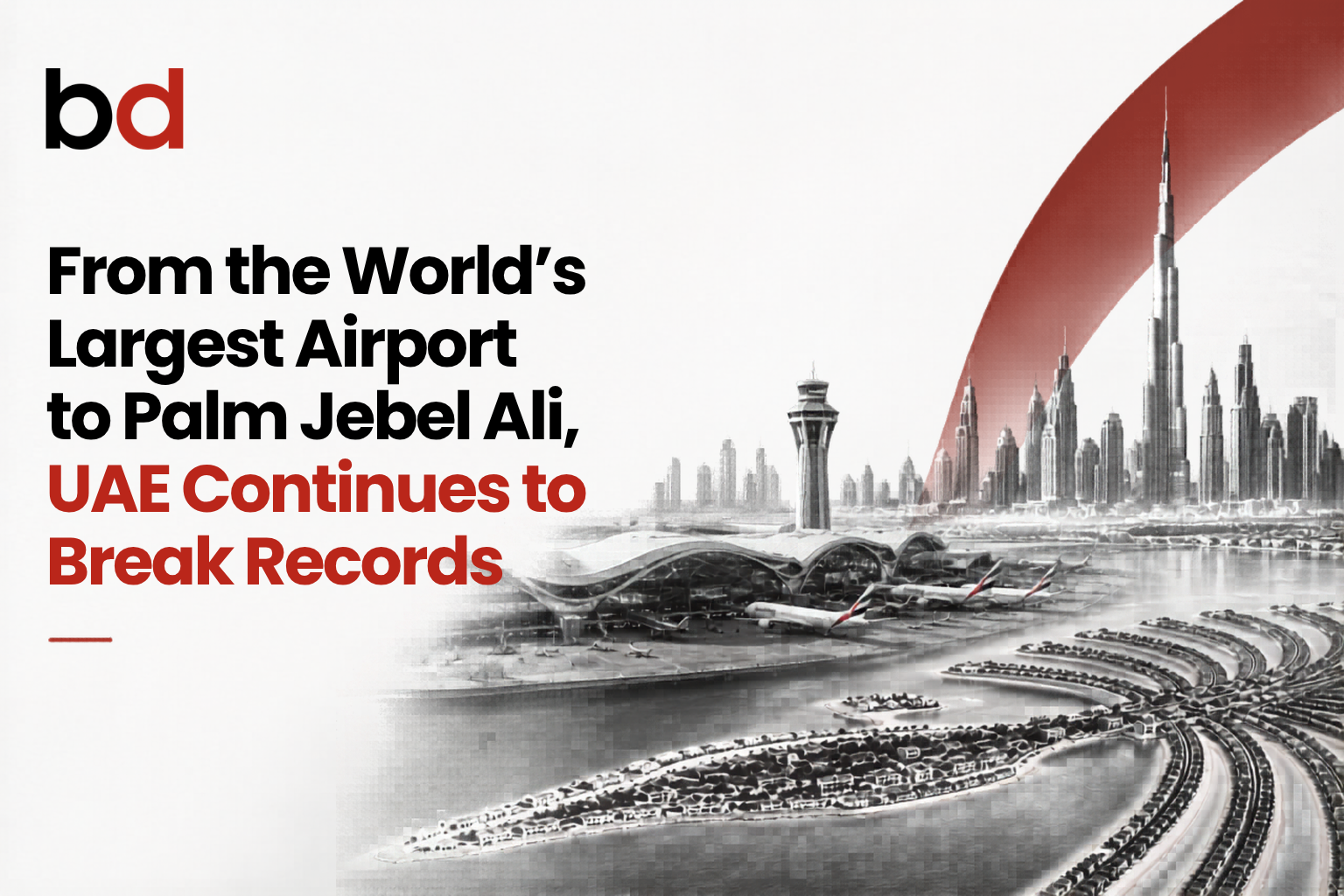
Once again, Dubai is rewriting global records—from the world’s largest airport to a giant construction project, the UAE infrastructure projects continue to break records. Its ‘New Dubai’ strategy aims at making it the world’s best growth center by combining aviation dominance, mega-real estate developments, an economy based on AI, and government momentum driving growth.
How New Dubai Is About to Set Another Record
Dubai’s record setting is not coincidental but strategic. The UAE government planned large-scale infrastructural projects for a sustained period of time to achieve an economic goal. DWC will soon become the world’s largest airport after 2027 and will have the capacity to serve over 260 million passengers each year. Palm Jebel Ali is almost double the size of Palm Jumeirah with 8,000 more houses and 50 million square feet commercial development.
| Project | Record-Breaking Scale | Timeline |
| Dubai World Central | 260M passengers/year, 6 runways | 2027 |
| Palm Jebel Ali | 2× Palm Jumeirah, 8,000 homes | 2028 |
| Expo City Dubai | Permanent innovation hub | 2025+ |
| Dubai Metro Expansion | 160km network, 5 new lines | 2026 |
The UAE government is backing its infrastructure projects financially.
Dubai’s AED 135B pipeline features various infrastructure projects including airports, metros, waterfronts, and AI cities. The “Dubai Economic Agenda D33” seeks to double the GDP to 33 trillion by 2033; infrastructure development will be key to economic growth.
Such an ambition is aided by several government policies such as foreign ownership up to 100%, zero corporate tax within the free zones, and the 10-year Golden Visa for investors and talents. These factors ease friction and promote flows of capital for investments.
Dubai Aviation Hub – Dubai World Central is set to become the world’s biggest airport
DXB already serves over 87M passengers per year. However, DWC promises to be a lot more impressive with six runways and an operating capacity of 260M passengers. Dubai will be able to connect 4 billion people through 8 hours’ flight from Dubai.
The aviation companies including Emirates and flydubai are increasing their planes’ fleet in line with DWC’s capacities. Autonomous vehicles, artificial intelligence technology and carbon-neutral facilities make DWC the world’s most innovative aviation hub.
Palm Jebel Ali: The Mega-Real Estate that will Rewrite Coastal Living
Palm Jebel Ali, unveiled in 2023 has since broken ground, set to be completed in 2028. This mega-real estate project will include more than 8,000 villas, 40 hotels, 50 million square feet of office space, and 1.5 km of private beach.
Apart from being a mega-luxury real estate development, it will boost the economy as it will create over 150,000 employment opportunities, bring $50 billion worth of investments, and add 1.5% to Dubai’s Gross Domestic Product (GDP). Foreign buyers are eligible for Golden Visa via property investments; thus, real estate is one of Dubai’s global investment destinations.
Mixed-Use Mega-Projects That Combine Aviation, Real Estate and AI Technologies
The projects under Dubai aren’t isolated initiatives but rather integrated eco-systems. For instance, Dubai South will consist of residential, commercial, and logistics centers. Furthermore, Expo City Dubai was turned into a permanent innovation hub featuring AI conferences and start-ups.
Such projects employ AI for managing their cities, self-driving transportation systems, and energy efficiency.
AI and Tech Enabling New Dubai’s Success
The “AI Everything” initiative by the Dubai government states that all services in Dubai must utilize AI by 2031. This will lead to a demand for AI startups developing solutions for smart cities, traffic control systems, and energy saving.
Dubai’s AI market will be worth $16B by 2030, with 30% being allocated on infrastructure development. The implementation of AI construction, drone delivery systems, and autonomous vehicles is being tested at Palm Jebel Ali and DWC.
Comparative Analysis of How New Dubai Stands Out from Other Global Cities
| Metric | Dubai | London | Singapore |
| Mega-Project Scale | 260M passengers + 8,000 homes | 1 airport + small islands | 1 airport |
| Foreign Ownership | 100% | 70% | 100% |
| Corporate Tax | 0% (freezone) | 17% | 19% |
| Visa Processing | 72 hours | 2 weeks | 3–4 weeks |
| GDP Growth Target | 2× by 2033 | 2% annually | 1.5% annually |
The Dubai model is much more favorable for global businesses compared to other cities.
The Real Change: From Tourist Destination to Hub of Infrastructure
Previously, Dubai was seen as a tourist destination characterized by luxury. The city is now constructing the world’s largest airport, largest man-made island, and an economy based on Artificial Intelligence. This change makes Dubai evolve from a mere consumer to a creator in terms of the development of infrastructure.
Conclusion
The new Dubai exemplifies that infrastructure can become a branding tool. With the establishment of DWC and Palm Jebel Ali among others, the UAE is making waves by engineering growth and not just following its pace. To position your brand amid Dubai’s emerging infrastructure trend, we at Brandiet offer services in brand audits and campaign blueprints.